This action will delete this post on this instance and on all federated instances, and it cannot be undone. Are you certain you want to delete this post?

Rahul Gopinath posted Apr 20, 2023
Pet peeve: In a number of research papers, I see that the bibliography is sorted by author name. The problem with this sorting is that it supports a single function --- to check how many times a particular author is cited in a printed paper as the first author. Unfortunately, when bibliographies are sorted in this fashion, it becomes very difficult to look up where in the paper that particular entry was cited. If you order the bibliography by the order in which it is referred to in the paper, it becomes much more easier for the poor reader to look up where and why a particular entry was cited in your paper.
IMO, the second function is much more important than the first. So, my plea to the authors: Please, order the bibliography by the order of reference.
Rahul Gopinath posted Apr 19, 2023
I am trying to introduce my students in software engineering to LLMs. I want them to have a good idea of what it is like to work with them, or to build tools on top of them. What is the best option currently?
Rahul Gopinath posted Apr 10, 2023
It seems that I have almost entirely replaced my use of Grammarly and LanguageTool with ChatGPT (GPT4). The ability to instruct the AI on what to do in different parts, --ignore latex comments, keep the structure, make abstract concise, make introduction simple etc.--are a real game changer for me. However, I find its ability to write code I want *extremely* lacking!.
Rahul Gopinath posted Mar 30, 2023
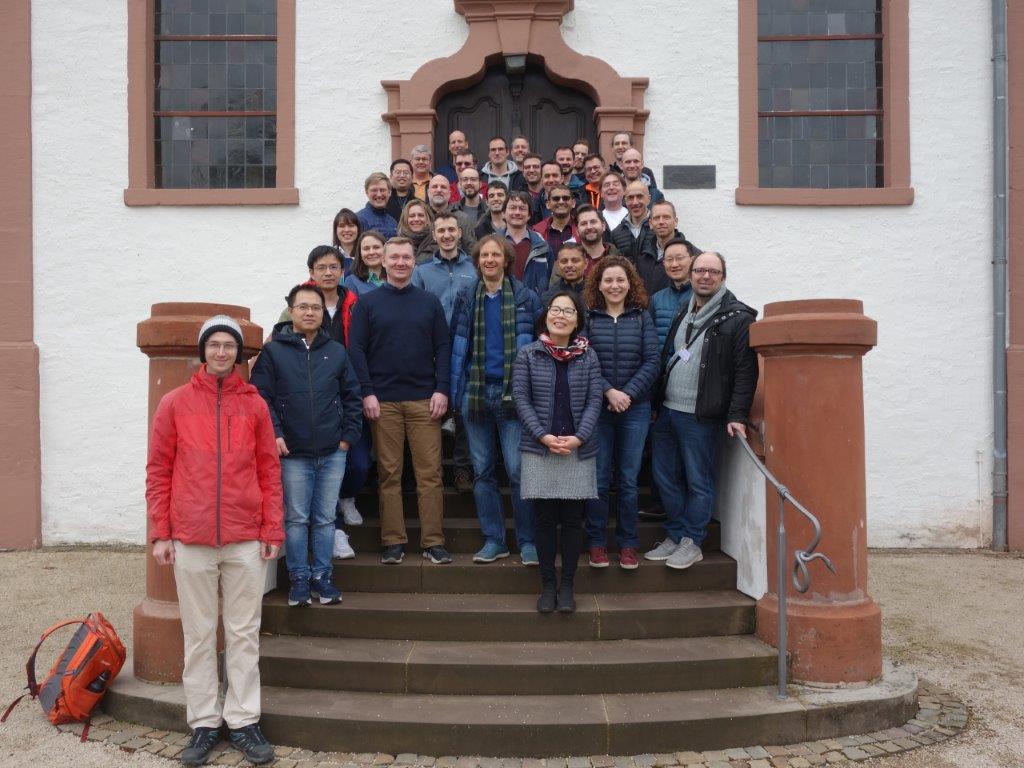
At Schloss Dagstuhl #dagstuhl finding bugs.
Rahul Gopinath posted Mar 17, 2023
Valiant's general context free parser is one of the few very well known general context free parsers. Its claim to fame is that given any context-free grammar, it can parse any strings in that grammar in less than O(N^3) time, by leveraging advances matrix multiplication. Unfortunately, lucid explanations of what Valiant's algorithm does is somewhat hard to find. I have just written a live notebook post that explains the Valiant's parser, and lets you play with the algorithm directly.
Rahul Gopinath posted Mar 16, 2023
An unforeseen (or perhaps foreseeable) issue; Most foot guns I have learned to avoid in Python are present in GPT4 generated code, and it is not immediately obvious anymore. Chased a surprising bug and found
C = [[{}] * m for _ in range(m)]
followed by
C[i][j][k] = "V"
buried deep. Because I trusted GPT4 (it aught to be good at these things) I failed to recognize this pattern :/
Rahul Gopinath posted Mar 16, 2023
It is very mesmerizing to get chatGPT+ (GPT4) to write code for you. It keeps making different mistakes every time, and inventing newer explanations!
Rahul Gopinath posted Mar 5, 2023
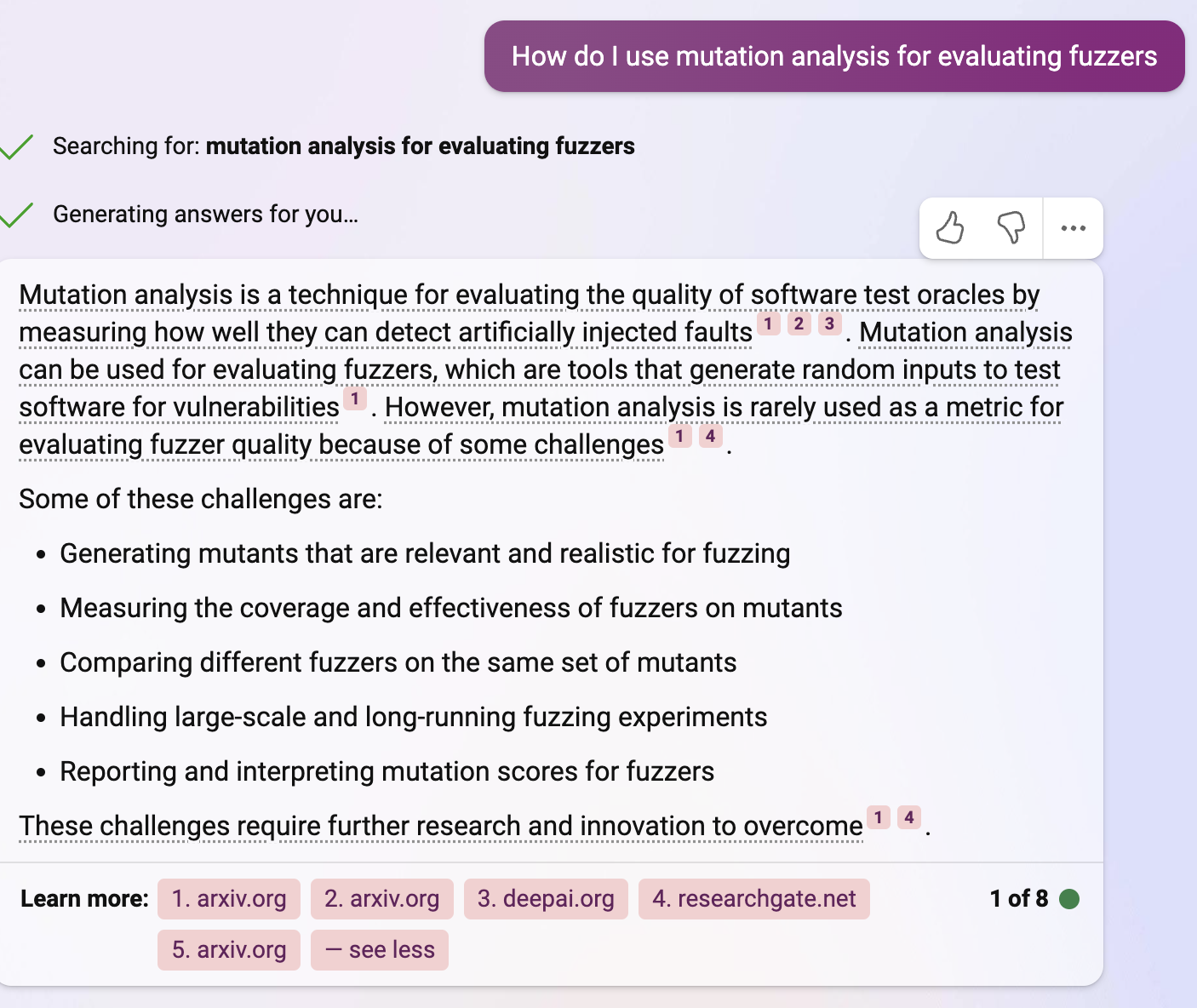
Experimenting with the new Bing (Sydney?), it seems that it has problems with citations still. In the below, all the links to the arxiv.org are the same paper I wrote some time back, and the one in research.org is also the same paper, albeit in a different cite.
Rahul Gopinath posted Feb 25, 2023
Rahul Gopinath posted Dec 18, 2022